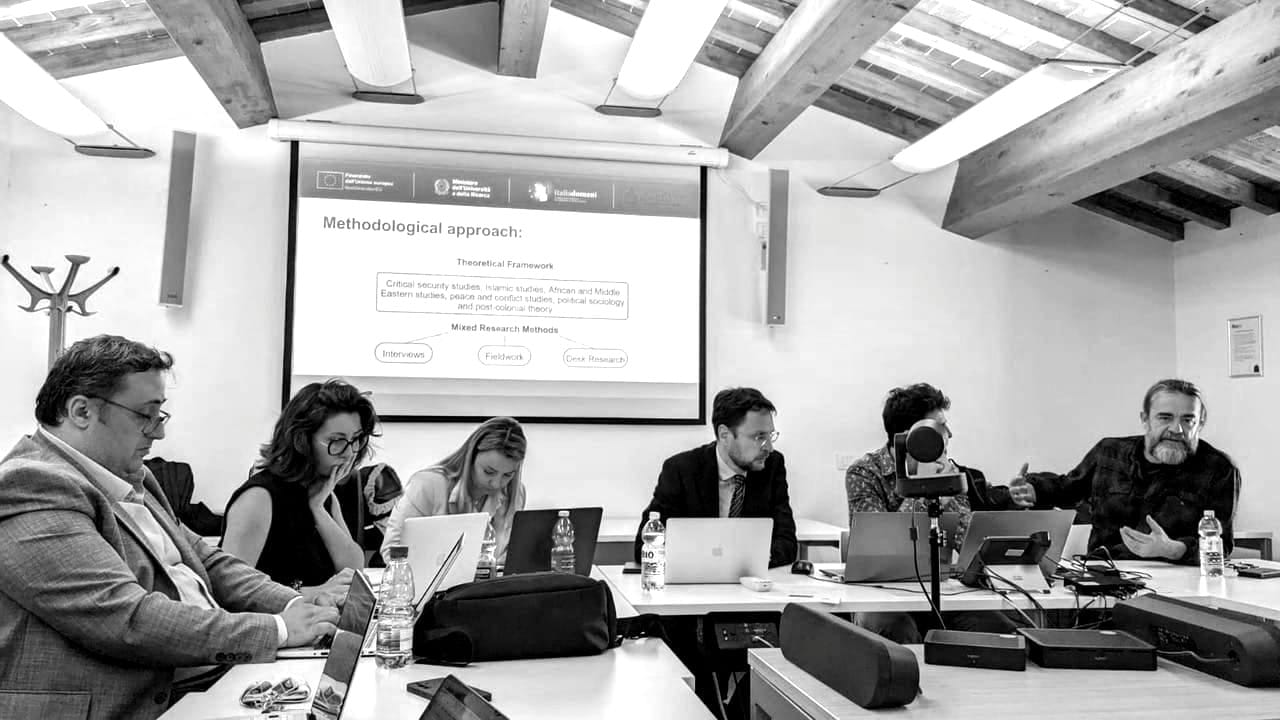

After more than two years of research, the NIJAR project—Negotiating with Islamist and jihadi armed groups: practices, discourses and mechanisms across Asia and Africa—funded by the Italian Ministry of University and Research has formally come to an end. Implemented between November 2023 and February 2026 by researchers at the Sant’Anna School of Advanced Studies and the Università Cattolica del Sacro Cuore, NIJAR set out to examine a politically uncomfortable but empirically unavoidable issue: how do dialogue and negotiation with militant Islamist and jihadi armed groups actually work across Africa, the Middle East, and Asia?
From the outset, the project aimed to do three things: map negotiation initiatives, understand the religious and political narratives that legitimize or oppose engagement, and refine a broader analytical framework on the conditions under which negotiations emerge, fail, or transform conflict dynamics. Now that the project has concluded, the first major set of NIJAR results is available through three working papers published on SPIRE. Together, they show that negotiations with jihadi and militant Islamist actors are neither anomalies nor signs of state weakness alone. They are recurring political practices, shaped by local power, ideological framing, religious authority, strategic calculation, and the limits of military force.
The first working paper, From Conflict to Contact: Negotiating with militant Islamist and jihadi groups in the Sahel and Middle East, lays the foundation. It starts from a simple but important point: scholarship on negotiations with militant Islamist and jihadi groups is still fragmented and often limited to isolated case studies. NIJAR’s first paper addresses this gap through a comparative overview of negotiation initiatives in the Sahel and the Middle East, combining broad mapping with deeper analysis of selected cases. Its core argument is that negotiations should not be treated as exceptional departures from “normal” conflict management, but as processes that already exist in many forms—formal and informal, overt and covert, local and international. The paper also shows that to understand these processes, we need to look beyond static labels and ask more specific questions: who talks, about what, through whom, under what pressures, and with what expectations?
The second working paper, by Amin Elias, pushes the debate in a direction that is too often neglected in peace and conflict research: doctrine. Negotiating with militant Islamist and jihadi groups in the Sahel and Middle East: Intellectual, Jurisprudential, and Historical Dimensions examines the intellectual and jurisprudential foundations that shape jihadist worldviews and negotiation postures. Drawing on fatwas, treatises, historical debates, and conceptual vocabularies, the paper explores how notions such as authority, legitimacy, takfir, hakimiyya, hudna, sovereignty, and the relationship to the “Other” influence how armed Islamist actors think about governance, compromise, and political engagement. The key takeaway is clear: negotiation is never just a technical or diplomatic process. It is also framed by long-standing doctrinal universes, and any attempt to understand whether engagement is possible has to take these intellectual and historical layers seriously.
The third working paper, by Ksenia Kumanina, brings the project’s empirical and comparative findings together. Talking with the Bad Guys? Findings on Negotiations with Islamist Armed Groups across Africa and the Middle East draws on case studies including Mali, Niger, Somalia, Lebanon, and Syria, while also incorporating comparative references to Afghanistan and Palestine. It shows that there is no single model of negotiation with militant Islamist groups. Instead, outcomes are shaped by a mix of factors: local embeddedness, internal group dynamics, political opportunity structures, state fragmentation, mediating actors, and competing visions of legitimacy. The paper also confirms one of the broader intuitions behind NIJAR: militarized approaches alone have often failed to produce long-term stabilization, while local and informal forms of dialogue—however messy, partial, or politically contested—have repeatedly emerged as part of the actual landscape of conflict management.
Taken together, the three papers point to several broader conclusions.
First, the old binary between “no talks” and “appeasement” is analytically unhelpful. In practice, dialogue already happens in multiple forms, including prisoner exchanges, humanitarian access arrangements, local ceasefires, informal mediation, and survival pacts between communities and armed actors.
Second, negotiations are not just about battlefield dynamics. They are also about discourse, authority, and legitimacy. Whether actors accept, reject, or reshape negotiation depends not only on military incentives, but also on the religious and political meanings attached to compromise, rule, justice, sovereignty, and violence.
Third, context matters enormously. NIJAR’s comparative work shows that what may open space for engagement in one setting can close it in another. Hyperlocal arrangements, trusted intermediaries, local religious authorities, and the specific political ecology of a conflict often matter more than abstract peacebuilding templates.
But NIJAR does not end with the working papers.
A major collective output of the project is the Special Issue After the War on Terror: Dialogue and Negotiation with Jihadist Groups in the Global South, which brings together NIJAR’s core contributions with articles by leading international scholars covering cases such as Mauritania, Mali, Niger, Somalia, Nigeria, Morocco, Palestine, Iraq, Lebanon, Syria, Afghanistan, and the Philippines. As the project team argued from the start, the issue is not whether negotiations with such actors exist—they do—but how they are framed, translated, resisted, and politically managed across very different contexts. The Special Issue expands this conversation well beyond the project’s initial case studies and places NIJAR’s findings into a wider comparative and international scholarly debate.
The project also invested in public dissemination through the podcast series Il dialogo invisibile, produced in collaboration with Fondazione Oasis and available on major platforms such as Spotify and Amazon Audible. Through three episodes dedicated to the Sahel (Sahel, quando la risposta militare non basta), Lebanon (Libano: se lo Stato è debole, lo è anche la società) , and Somalia (Somalia: dopo quarant’anni di guerra è arrivato il momento del dialogo?), the series translated some of NIJAR’s core questions into a more accessible format: is it possible to negotiate with jihadi groups, under what conditions, and with what political implications? In doing so, the podcast extended the project’s reach beyond academia and policy circles, helping bring these debates to a wider public audience.
In that sense, the working papers and the special issue are both a conclusion and an invitation. They mark the end of the project, but they also open up a broader agenda for research and debate on negotiation, mediation, and conflict transformation in contexts shaped by militant Islamist violence.
More on this soon in the forthcoming Special Issue. Stay tuned.