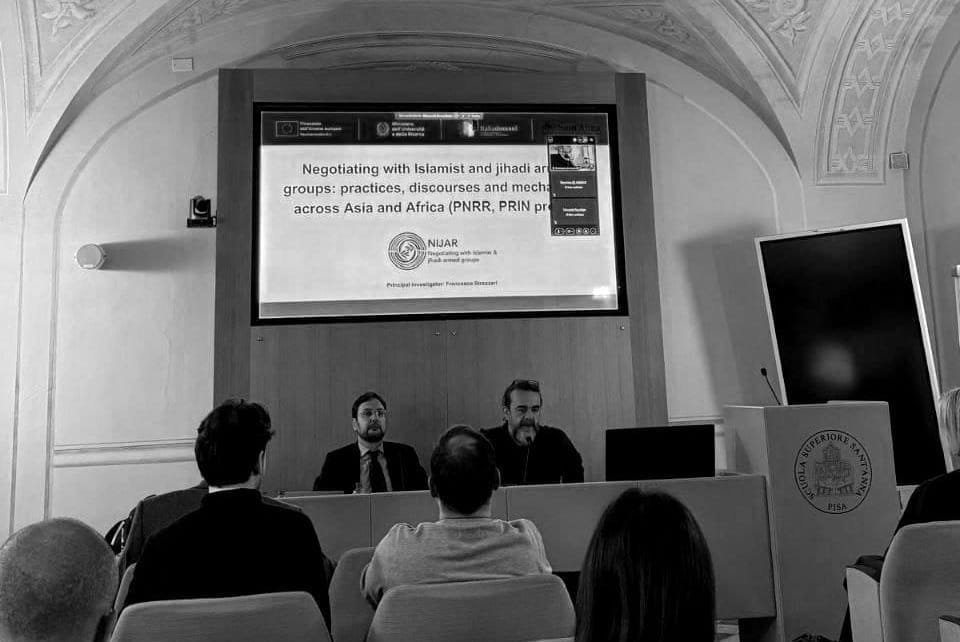

On 3 February 2026, the research team of the NIJAR project hosted a final conference at Sant’Anna School of Advanced Studies, presenting the project’s findings and building cross-institutional dialogue with researchers and practitioners from Europe, the Middle East, and Sub-Saharan Africa.
The project “NIJAR – Negotiating with Islamist and jihadi armed groups: practices, discourses and mechanisms across Asia and Africa” is a 24-month research initiative launched in December 2023, funded by the Italian Ministry of University and Research under the Research projects of relevant national interest (PRIN PNRR), with the support of the Next Generation EU Fund. Led by the Sant’Anna School of Advanced Studies and the Catholic University of the Sacred Heart, NIJAR investigated the factors enabling or impeding negotiations with militant Islamist and jihadi groups across five case studies: Afghanistan, Mali, Niger, Somalia, Lebanon, and Syria.
The workshop offered a unique opportunity to share NIJAR’s findings and spark comparative reflection across diverse settings and sectors. After the welcome note by the project’s PI, Francesco Strazzari, Scuola Superiore Sant’Anna, and co-PI Martino Diez, Università Cattolica del Sacro Cuore. The opening session recounted how the NIJAR project first took shape, traced its main developments over time, and clarified its theoretical premises and methodological choices within peace and conflict studies. Strazzari and Diez also reflected on the key challenges encountered throughout the project’s implementation, including not only the rapidly shifting dynamics on the ground in the Sahel, but also major transformations in the wider research landscape and conflict environments in Lebanon and Syria, which required continuous analytical and operational adaptation. Olivier Roy, European University Institute, gave the keynote speech reflecting on the changes within the doctrinal framing of jihadi and Islamist groups over the last twenty years, linking theological variations with the formative years of what is commonly referred to as the Global War on Terror (GWOT).
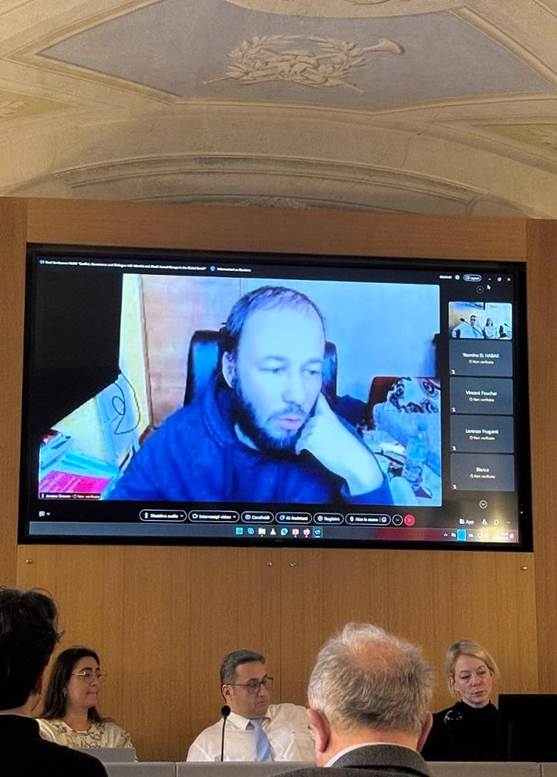
The conference then turned to contributions of the first panel “The Middle East and Asia: Jihadist movements, negotiation and political order”chaired by Simone Tholens, John Cabot University in Rome. Amine Elias, UniCatt, (post-doc researcher from the NIJAR project) shared his research findings on Lebanon-based Hezbollah and Syria-based Hay’at Tahrir al-Sham (HTS). He emphasised that all forms of negotiations and truces made with adversaries were merely temporary tactics aimed at seizing governance control. Elias also stressed that the Middle Eastern states’ fragility is reflected in the weakening of official Islamic religious authorities, with jihadi and Islamist groups filling this vacuum. Jérôme Drevon, International Crisis Group and Graduate Institute, further shared analytical observations on the current situation in Syria, reflecting on the sanctions relief and international rehabilitation achieved by transitional President Ahmed al-Sharaa, a former al-Qa’ida (AQ) commander, in a span of one year. Drevon also highlighted such domestic challenges as informal power concentration among the HTS members, ongoing ethnic clashes, and an unstable security sector. Mona Kanwal Sheikh, Danish Institute for International Studies, provided a cross-case comparison on dialogue framing with jihadi groups. She reflected on how conflict bundles and treatment of jihadism as a particular/separate form of conflict may lead to over-generalised findings and stressed the need to simplify analytical frameworks and relocalise the conflict to create effective context-specific engagement and response strategies. Lastly, the panel interrogated whether the HTS “model” of success in Syria can be adopted by other global jihadi and Islamist groups. The panel concluded that the HTS’s goal was and still is long-term normalisation, which suggests several concessions that more radical jihadi groups simply would not view as acceptable. Any dialogue initiative or peace settlement is context-specific, with fundamental goals, level of internal fragmentation, shape of political agenda, governance approach, and overall positioning in regional and international contexts being the very determinants of their engagement strategy.
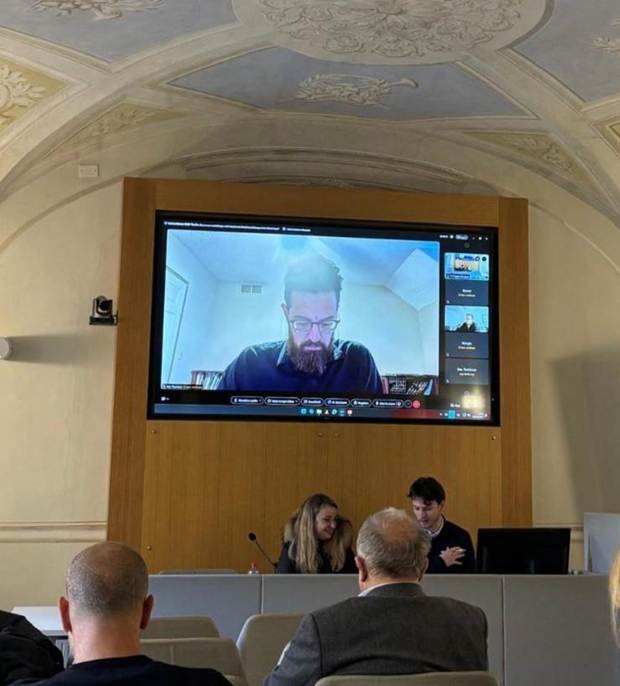
The second panel, “African Trajectories of Dialogue with Jihadist Groups,” was chaired by Théo Blanc (Scuola Superiore Sant’Anna / European University Institute). Alexander Thurston (University of Cincinnati) discussed the enabling conditions and political logics of dialogue in Mauritania; Laura Berlingozzi (Scuola Superiore Sant’Anna; NIJAR post-doctoral researcher) presented evidence on local-level dialogue practices in the Sahel; and Vincent Foucher examined the challenges of deradicalisation and rehabilitation in Nigeria. Thurston emphasised how Mauritania’s counter-terrorism approach—which has prioritised dialogue and deradicalisation alongside security measures—has contributed to reducing terrorist attacks within the country. Berlingozzi shared findings on community-led engagement and negotiations with jihadist actors in Mali and Niger, showing how entering into negotiations often serves as a survival strategy for local communities amid the institutional void created by minimal to no state presence. Her analysis unpacked the difference among the models of negotiations relative to a group’s transnational affiliation, stressing the pragmatic nature of dialogue and its fragility/vulnerability to violence outbreaks and deeply rooted ethnic conflicts. While discussing his experience in interviewing defectors from Boko Haram, Foucher shed light on several challenges within the programme implementation: poor screening and misclassification of participants, unsuitable hosting facilities, and difficulties of former combatants’ reintegration with local communities. The panel further dedicated significant time to discuss current developments on the ground in West Africa, particularly focusing on the fuel blockade AQ-affiliated Jama'at Nusrat al-Islam wal-Muslimin (JNIM) has been holding since autumn 2025 in Mali. Against this backdrop, participants discussed emerging reports of informal entry points for dialogue involving local intermediaries, underscoring the continued practical relevance of negotiation for the region’s future stability.
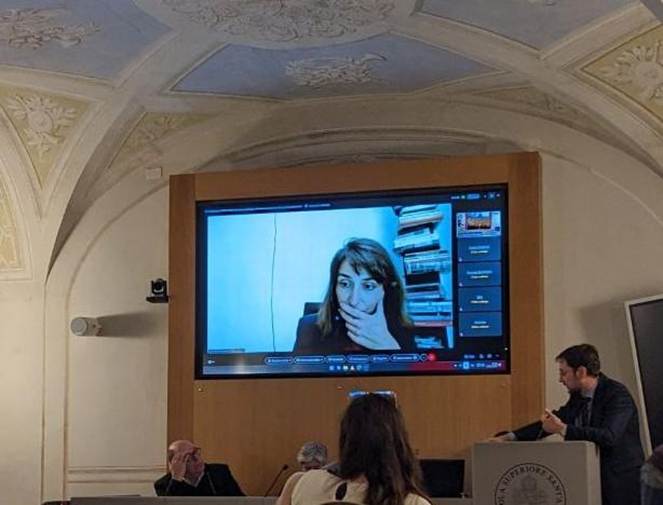
The conference continued with a roundtable titled “Engaging jihadist armed groups: Policy dilemmas and practical lessons”, chaired by Alessandro Banfi (Fondazione Oasis) and moderated by Martino Diez (Università Cattolica del Sacro Cuore). The session brought together leading practitioners from non-governmental and international organisations directly involved in mediation, dialogue initiatives, and humanitarian diplomacy: Bernardo Venturi (President, Agency for Peacebuilding), Véronique Dudouet (Senior Research Advisor, Berghof Foundation), Francesca Caruso (Senior Analyst and Conflict Mediator, Comunità di Sant’Egidio), and Salvatore Vicari (Humanitarian Diplomacy Adviser, World Food Programme).
Speakers shared converging field-based lessons and recurring dilemmas, highlighting in particular the challenges of securing humanitarian access, the institutional hesitations and constraints that often discourage engagement, and the persistent gap between ground-level realities and the way crises are framed and addressed at regional and international levels. Overall, the discussion underscored that decisions to engage are shaped by a constant balancing act between mandates and principles, risk management, and the need for pragmatic, context-sensitive approaches.
Overall, the conference was an important milestone for the NIJAR research team to share two-year research findings, engage in interdisciplinary dialogue, and situate discussion in the ever-evolving dynamics of jihadi and Islamist groups on the ground in Sub-Saharan Africa, Asia, and the Middle East. As the project’s research outputs near completion, we invite you to stay tuned for the forthcoming final Working Paper and for the Third World Quarterly Special Issue, “After the War on Terror: Dialogue and Negotiation with Jihadist Groups in the Global South,” scheduled for publication in 2026. The Special Issue will bring together contributions spanning a wide range of contexts, including Mauritania and the Sahel, Somalia, Nigeria, Lebanon, Syria, Palestine, Iraq, Morocco, Afghanistan, and the Philippines.
To listen to the NIJAR research team’s latest outputs, please find below three recent podcasts:
● Marta Cavallaro. Somalia: dopo quarant'anni di guerra è arrivato il momento del dialogo? Podcast, Fondazione Oasis
● Laura Berlingozzi. Sahel, quando la risposta militare non basta. Podcast, Fondazione Oasis
● Amine Elias. la società Libano: se lo Stato è debole, lo è anche la società. Podcast, Fondazione Oasis