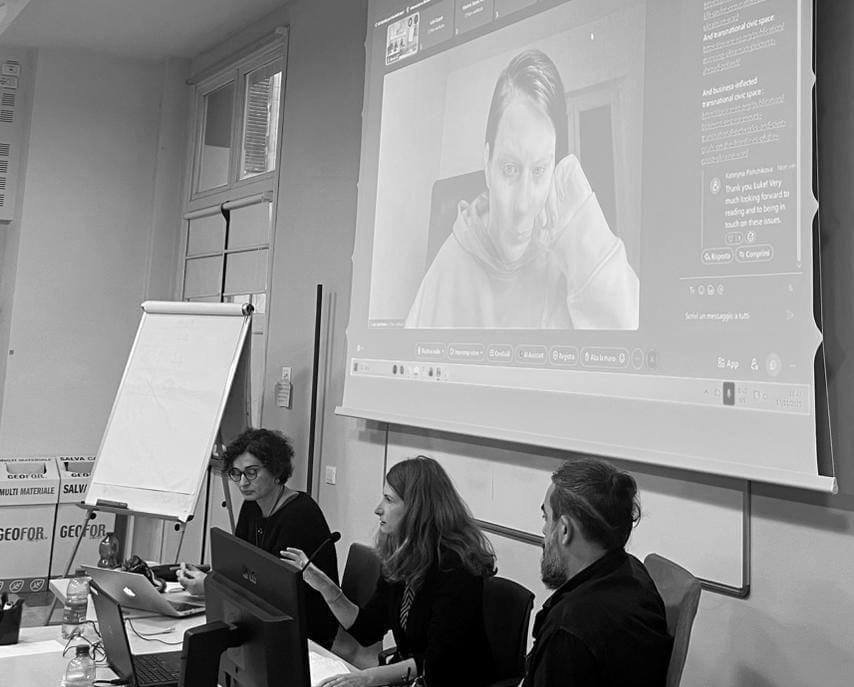
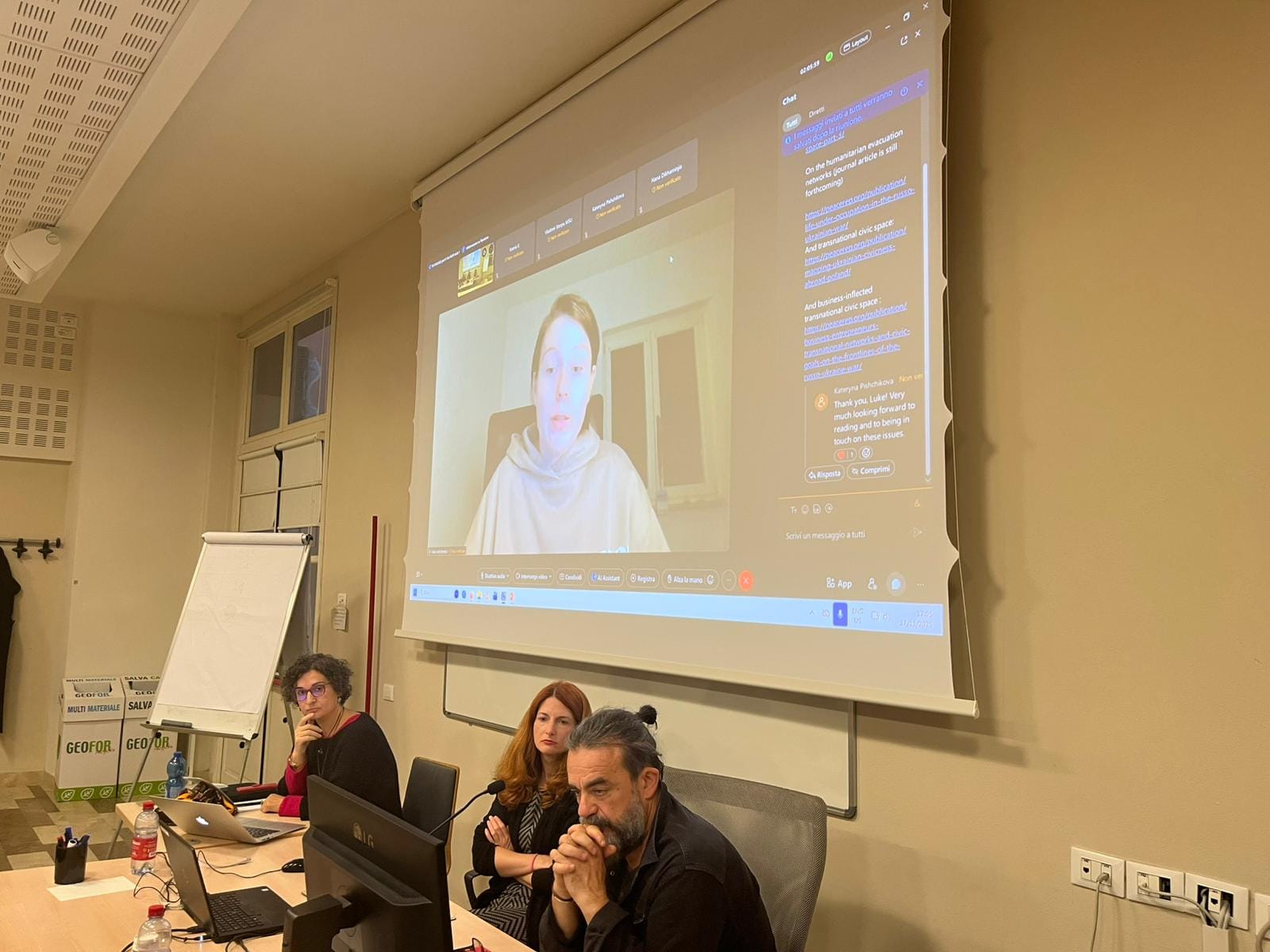
On 17 November 2025, Professor Francesco Strazzari and Dr. Sophie Gueudet, within the framework of the Horizon Europe research project RE-ENGAGE, organised a workshop at the Sant’Anna School of Advanced Studies entitled Democracy on the Brink: Democratic Crises, Authoritarian Threats and Collective Resistance. The programme began with two panels focusing respectively on the structural roots of the authoritarian drift in Georgia and on the impact of the Russian full-scale war on Ukrainian democracy and civic space.
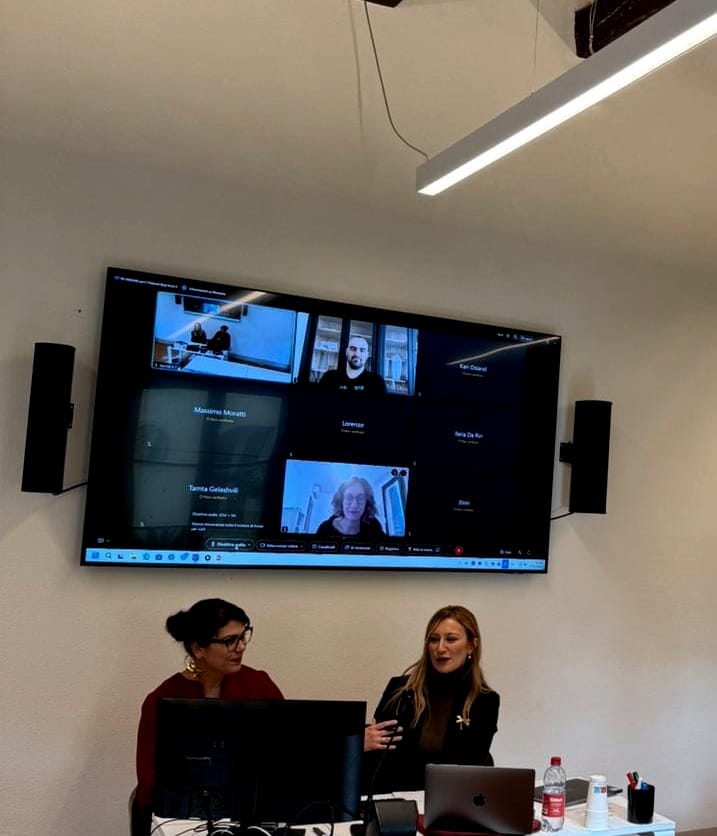
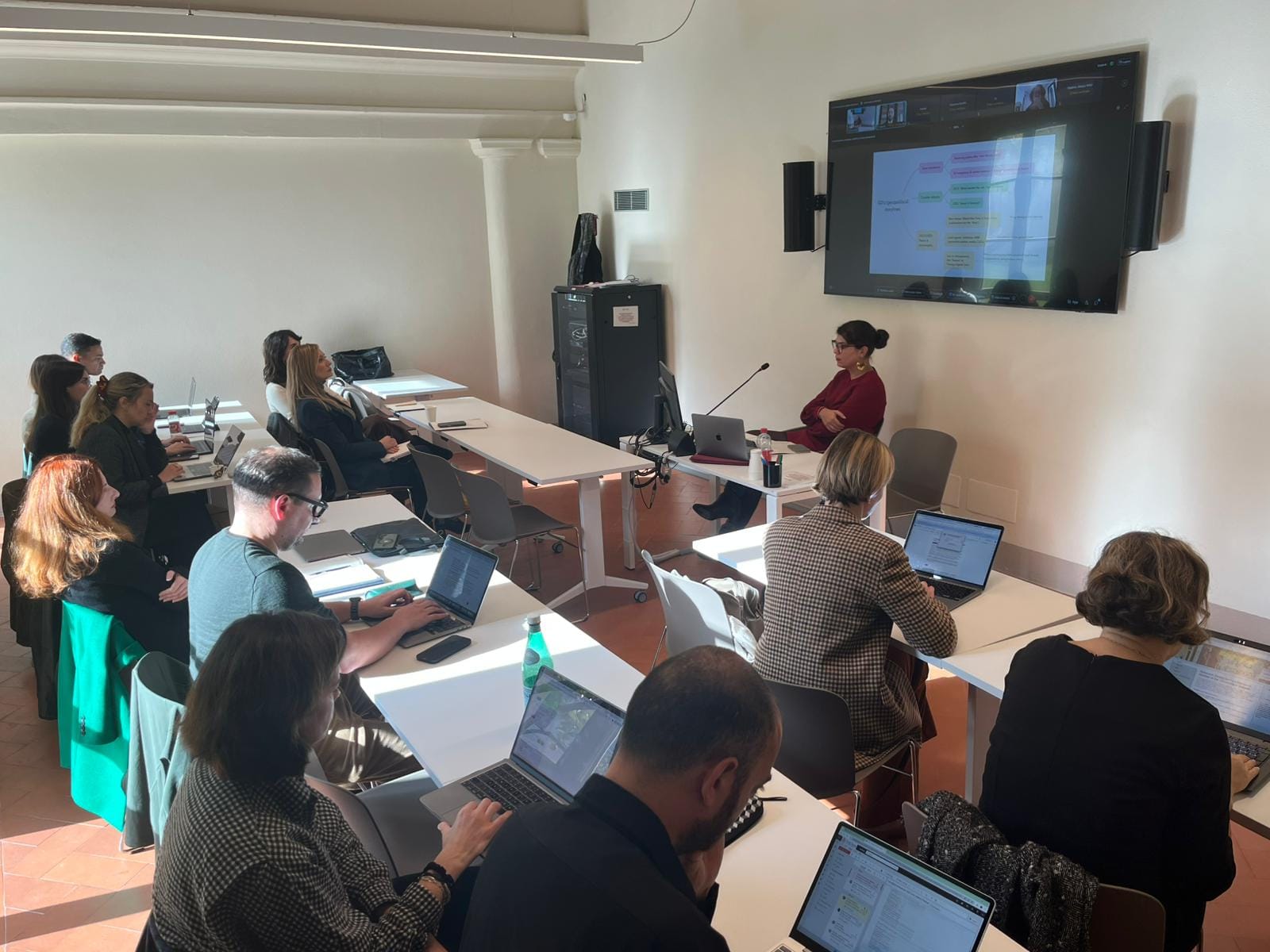
These sessions were followed by a dedicated roundtable on academic activism, which brought together Dr. Biljana Đorđević (Zeleno-levi front, University of Belgrade), Dr. Sevgi Doğan (University of Pisa), Dr. Nana Dikhaminjia (University of Georgia), and Dr. Iuliia Iashchenko (Sapienza University). Drawing on cases from Serbia, Türkiye, Georgia, and Ukraine, the roundtable discussion examined the role of universities and student activism in contexts of authoritarian shift, democratic instability, and armed conflict. Despite substantial contextual differences, the discussion highlighted shared dynamics shaping the role of universities and the mobilisation of faculty members and students within contentious political environments.
Universities as arenas of political contestation and state intervention
Across the four interventions, universities consistently emerged as key arenas where state power, political opposition, and civic mobilisation intersect. In Serbia, Türkiye, and Georgia, participants described direct state intervention into higher education governance, while the Ukrainian case demonstrated how similar constraints can arise indirectly through crisis-driven resource reallocation.
Biljana Đorđević’s discussion of Serbia and Sevgi Doğan’s analysis of Türkiye both pointed to governance capture as a central mechanism through which political authorities limit academic autonomy, whether through the expansion of government-appointed representatives on university management boards in Serbia or long-standing centralised oversight under the Turkish Higher Education Council. Dr. Nana Dikhaminjia’s account of Georgia illustrated a more accelerated version of this process, where proposed Soviet-style reforms aim to introduce full state control over public universities, accompanied by restrictions on foreign student admission and teaching staff quotas. While Dr. Iuliia Iashchenko emphasised that Ukraine’s constraints stem from wartime necessity rather than authoritarian intent, the redirection of funding away from social sciences and the physical disruption of university infrastructure similarly weaken universities’ capacity to function as autonomous institutional actors. Taken together, the cases demonstrate that higher education systems become politically salient targets under conditions of democratic stress, regardless of whether pressure is exerted deliberately or indirectly.
Institutional autonomy, inter-university cooperation, and protest capacity
The roundtable further highlighted how variations in institutional autonomy shape the form and sustainability of academic activism. Đorđević’s analysis of Serbia underscored the importance of retained self-management democratic structures, which help explain the comparatively high level of inter-university cooperation and the ability of Serbian universities to adopt an overtly political stance, particularly in the wake of the Novi Sad tragedy and subsequent alliance-building with civil society and opposition movements.
This capacity was explicitly contrasted with the Turkish case presented by Doğan, where decades-long state control have significantly eroded intra- and inter-university cooperation. The routine investigation of dissent by the Higher Education Council renders academic and student participation in protest largely indirect, limiting collective mobilisation despite shared grievances over autonomy and funding. Dikhaminjia’s account of Georgia suggests a trajectory moving closer to the Turkish model, as intensified repression and legal restructuring coincide with a sharp decline in student protests compared to 2024. Ukraine, while distinct in political context, was described by Iashchenko as facing structurally comparable limitations, where lack of funding, closure of mobility programmes, and insufficient research training constrain collective academic action. Across the cases, institutional autonomy emerges as a key enabling condition for visible mobilisation, while its erosion corresponds to fragmentation or demobilisation.
Politicisation and containment of student activism
Student activism constituted another cross-cutting theme linking the interventions. In Serbia, the 2021 law on the co-option of student representation directly politicises student organisations by making registration contingent on regime-linked affiliations, reshaping activism from within universities. Türkiye’s experience reflects a longer-term normalisation of similar dynamics, where institutionalised oversight discourages overt dissent and channels student activism away from formal university spaces.
Georgia’s case, as presented by Dikhaminjia, demonstrates how politicisation is reinforced through coercive and discursive mechanisms, including fines, administrative detention, expanded CCTV surveillance, and narratives portraying students and independent institutions as anti-state or foreign-influenced. While Ukraine does not exhibit comparable legal or coercive constraints, Iashchenko’s intervention showed that material deprivation and isolation can similarly limit student participation and academic engagement. Across all four cases, student activism is either actively politicised or structurally constrained, narrowing the space for universities to function as sites of collective opposition.
Academic isolation and the erosion of democratic resilience
A final thematic linkage across the presentations concerns the weakening of inter-university and transnational academic ties. Dikhaminjia’s discussion of Georgia highlighted how proposed reforms undermine international accreditation and mobility partnerships, including Erasmus+, contributing to intellectual isolation. Doğan’s analysis of Türkiye pointed to reduced research funding and long-standing constraints on international cooperation as consequences of entrenched state control. Serbia, while still benefiting from higher levels of inter-university cooperation, faces growing pressures amid privatisation and governance intervention.
Ukraine’s case parallels these dynamics through different means. As Iashchenko noted, the closure of mobility programmes and insufficient international financial support since 2022 have curtailed research output and engagement with European academic institutions. Across all interventions, the weakening of academic mobility and cooperation was shown to exacerbate institutional fragility, limiting universities’ ability to contribute to democratic debate and reinforcing broader patterns of democratic decline.
Academic activism as a lens on democratic erosion
Taken together, the roundtable discussions demonstrate that academic activism is shaped less by formal regime type alone than by institutional autonomy, the duration of political interference, and access to inter-university and transnational academic networks. Serbia illustrates how residual self-governance can sustain mobilisation, while Türkiye and Georgia show how long-term or accelerating authoritarian control restructures universities into increasingly compliant or isolated institutions. Ukraine, though not authoritarian in intent, reveals how crisis-induced constraints can generate comparable outcomes for academic freedom.
Across all cases, pressures on higher education do not eliminate agency. They severely constrain it, but also reshape it, as evidenced by the courageous and enduring forms of resistance articulated during the roundtable, most of them unfolding under conditions of intensifying repression, widespread impunity, and contexts in which the rule of law and public institutions are weakened or actively instrumentalised in support of regime consolidation.