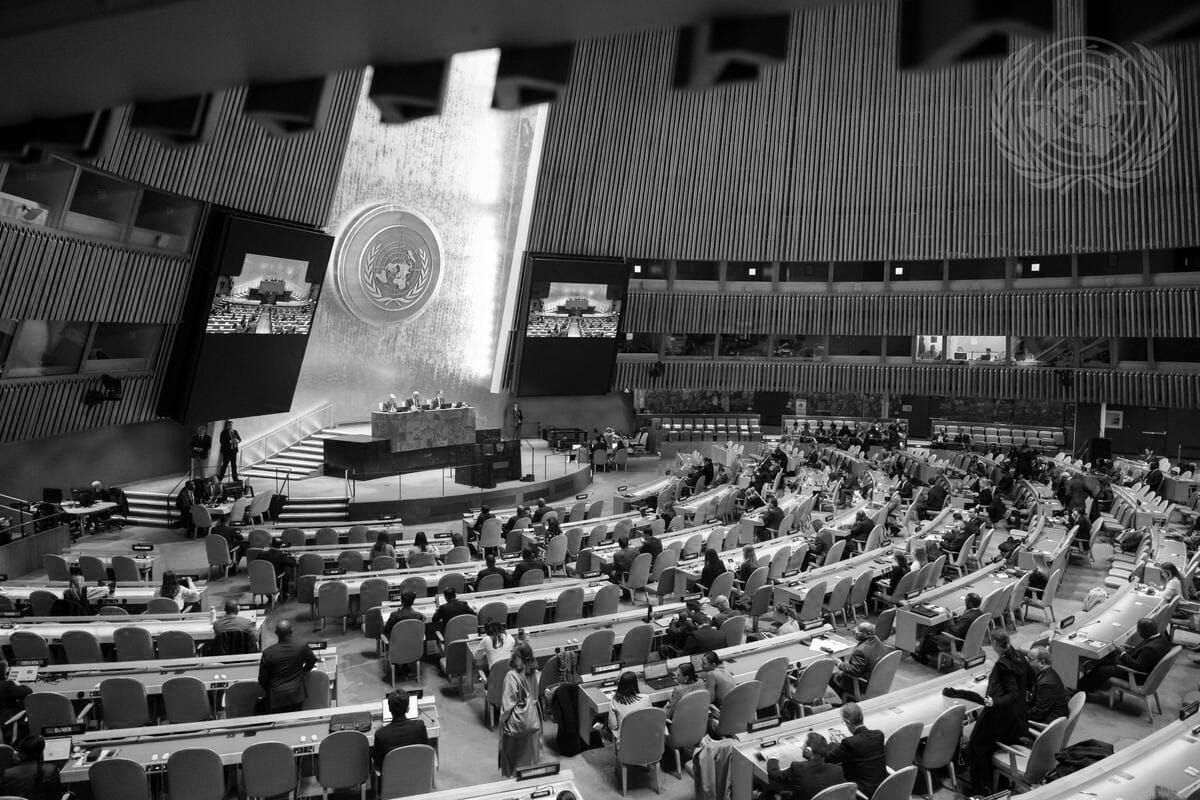
On 25 March 2026, the United Nations General Assembly adopted a resolution formally declaring the transatlantic slave trade 'the gravest crime against humanity'. Driven by Ghana under President John Dramani Mahama, and framed with deliberate diplomatic care — 'not to attribute collective guilt', but to draw a line from 18th-century plantations to 21st-century structural inequalities — the text passed with 123 votes in favour, 3 against, and 52 abstentions. The numbers, however, tell only part of the story. What the vote has exposed is one of the deepest fault lines in the contemporary international order: a fracture that runs not simply between North and South, but between those who carry — and those who do not carry — the legal and reputational burden of Atlantic colonial history.
The resolution is non-binding. Its architects know this. What they are building is something subtler: a doctrine of historical responsibility assembled incrementally through the logic of norm entrepreneurship — symbolic recognition today, diplomatic pressure tomorrow, legal claims at the International Court of Justice the day after. It is this trajectory, more than the text itself, that explains why the votes were cast as they were.
Three Votes Against: Internal Colonialism and Settler Logic
The sole three votes against — the United States, Israel, and Argentina — are not random. Analysed through the postcolonial historiographical framework of internal colonialism and settler colonialism, they form a coherent, if uncomfortable, cluster.
The United States was a slave-owning society for nearly two centuries. After formal abolition, it practised what Robert Blauner called internal colonialism: Black American communities were not assimilated like European immigrant groups but incorporated through mechanisms of political and legal control, economic exploitation, and cultural suppression. Alongside this, the continental conquest was settler colonialism in its most complete form — expropriation, deportation, and the destruction of indigenous peoples as the precondition for white settlement. A vote in favour would have reopened domestic fronts that the Trump administration has already sealed: Diversity, Equity and Inclusion policies have been dismantled, and even the modest proposal for a reparations study commission has been buried. The anti-reparations stance has been bipartisan for decades; MAGA is now radicalising it into doctrine.
Israel invoked the risk of constructing a hierarchy of crimes against humanity that would relativise the Holocaust — an argument with genuine philosophical roots in the 1980s Historikerstreit, the German historians' controversy over the comparability of Nazi crimes. The argument is not dishonest, but it sidesteps a structural contradiction: the doctrine Israel is defending against would apply with force to its own history of settlement, expropriation, and demographic management in Palestinian territory.
Argentina's no cannot be reduced solely to Milei's ideological performatism. Beneath it lies a deeper architecture: the campaña del desierto of the late 19th century exterminated or expelled the indigenous populations of Patagonia and the Chaco; national identity was consciously constructed as white and European, systematically erasing indigenous, African, and mixed-race components through replacement immigration. Milei's rejection of any interpretation of history as a source of present-day obligations is not an aberration — it is the logical endpoint of this founding myth.
What unites these three is not legal argument but structural exposure: each carries a history that the resolution's logic, if extended consistently, would implicate. They voted no not because the text was philosophically flawed, but because the precedent it sets is one they cannot afford.
The BRICS Vote: Strategic Asymmetry, Not Ideological Solidarity
The unanimous yes from Russia, China, Brazil, and India within the BRICS bloc has been read in some quarters as a contradiction: these are states that have historically resisted retrospective legal accountability and resented norm entrepreneurship emanating from Western multilateral institutions. The apparent paradox dissolves once one examines the structure of incentives.
Russia and China have never been actors in the Atlantic slave trade. Their traditional objections to historical reparations have always concerned exposure in their own regard — particularly as applied to Soviet or imperial Chinese conduct — not in the abstract. Voting yes cost them nothing legally. What it bought them was substantial: alignment with the African bloc (the largest regional group in the General Assembly), a low-cost demonstration of solidarity with the Global South at a moment when both Moscow and Beijing are engaged in intense competition for influence across sub-Saharan Africa, and a high-visibility opportunity to highlight the abstentions of former colonial powers. The geopolitical calculus is one of asymmetric returns: maximal reputational gain at zero legal risk.
Putin's domestic deployment of anti-wokism — positioning feminist, Black Lives Matter, and postcolonial critique as instruments of Western globalist destabilisation — does not contradict this vote; it runs parallel to it. At the UN, one performs sovereignty-in-solidarity-with-the-South; at home, one performs rejection of the ideological framework that underwrites such solidarity. The two registers coexist without difficulty because the vote is strategic, not principled.
Brazil is the case that deserves most careful disaggregation. The country received approximately 4.9 million enslaved Africans — the largest share in Atlantic history. The Lula government's domestic programme (racial quotas, the Ministry of Racial Equality under Anielle Franco) explicitly acknowledges the historical debt. Brazil's yes vote is therefore both strategically rational and domestically consistent — rare alignment in geopolitics.
India's position is more complex: a postcolonial state that has itself experienced colonial extraction, but one wary of mechanisms that might generate redistributive obligations at international level. Yet the calculation resembles that of Russia and China: the vote carries no legal exposure and reinforces India's positioning as a leading voice of the Global South.
Read collectively, the BRICS vote is a textbook exercise in what might be called fault-line diplomacy: the strategic exploitation of a fissure in the international order to reposition the bloc as the legitimate representative of planetary historical justice, while the actual burden of reckoning falls elsewhere.
The Abstentions: Reputational Vulnerability and the European Position
The 52 abstentions included the United Kingdom and the entire European Union — a bloc constituted, almost to a member, by states that were either direct architects of the Atlantic slave trade, colonial empires built on enslaved labour, or both. Their stated objections were largely technical: contestation of the hierarchy of crimes argument, concerns over the resolution's legal architecture, discomfort with the reparations language. These are not frivolous objections. But the political effect of the abstention is unambiguous: the states most historically implicated in the crime the resolution names declined to vote for it.
For the EU, this creates a reputational vulnerability that African partner states will exploit in bilateral and multilateral settings. Abstention has left Brussels simultaneously exposed to the accusation of historical evasion and deprived of the moral authority that a yes vote would have conferred — authority that would have been genuinely useful in African Union negotiations, trade discussions, and migration diplomacy.
The difficulty European states face is structural: they cannot easily distinguish between acknowledging moral responsibility and accepting individual legal liability. Washington made explicit what Brussels left implicit — that current generations cannot be considered compensating beneficiaries for past crimes. It is a position that, while legally defensible in narrow terms, fundamentally misreads the architecture of the resolution, which deliberately does not name individual states as defendants.
Italy: A Paradigmatic Silence
Italy's abstention invites specific analysis, for reasons that go beyond its vote. Italy was not a participant in the transatlantic slave trade, but that does not place it outside the history the resolution engages. Pre-unification Italian actors operated within Iberian colonial systems; unified Italy developed its own forms of colonial exploitation, based on forced labour and systemic violence across Libya, Eritrea, Somalia, and Ethiopia.
Unlike Germany, which established reparation mechanisms for Holocaust victims resulting in over €80 billion in compensation and formal agreements with the State of Israel, and unlike Belgium, which formally apologised in 2021 for colonialism in the Congo (a regime responsible for between five and ten million deaths under Leopold II), Italy has never adopted a systematic institutional position on its colonial crimes. As historian Nicola Labanca wrote in his Oltremare (2002), this remains 'unfinished and uneven'. Angelo Del Boca, who spent decades documenting — and fighting the erasure of — Italian colonial violence, from mass deportations in Cyrenaica to the use of mustard gas in Ethiopia, found that his conclusions never entered Italian public consciousness. There is no national law recognising colonial crimes, no fund for descendants of victims, no national museum of colonisation comparable to those in Brussels, Paris, or Amsterdam.
The Libyan case constitutes a partial exception that illuminates the rule. The 2008 Treaty of Friendship signed by Berlusconi and Gaddafi included formal apologies and financial commitments for the colonial period — the concentration camps, deportations, the execution of Omar Mukhtar. But as Labanca observed, those gestures are better understood as migration policy than historical reckoning: in essence, an arrangement for Libya to manage migration routes. Memory as a bargaining chip.
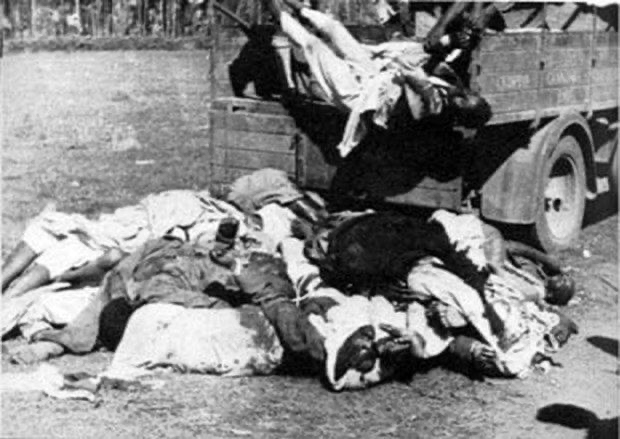
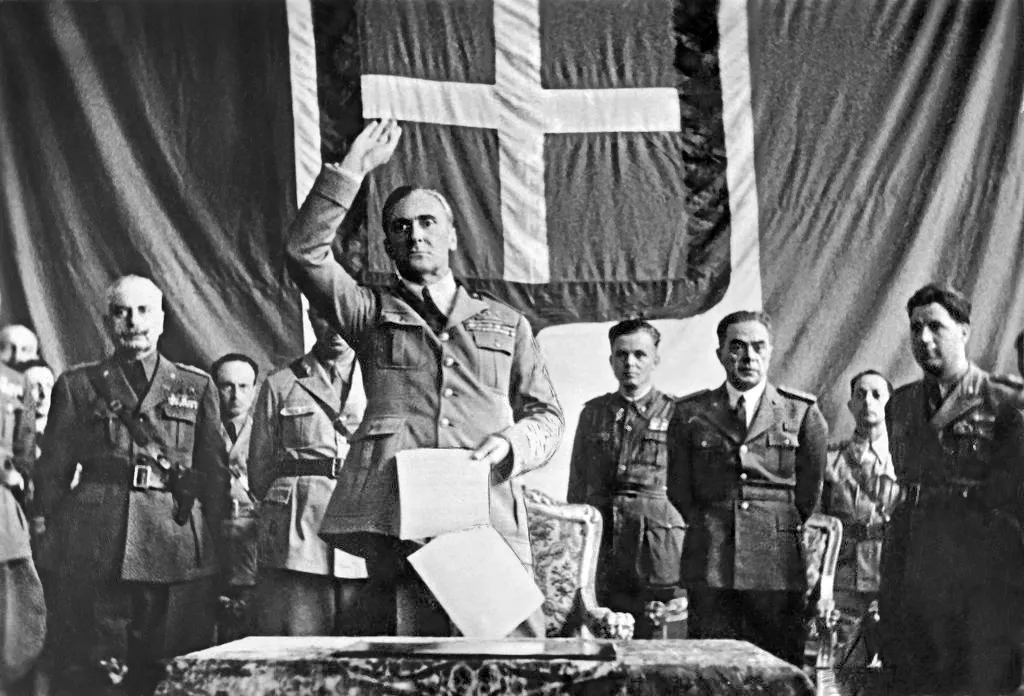
For Ethiopia, there has been nothing comparable. On 19 February 1937 — Yekatit 12 in the Ethiopian calendar — after two Eritrean resistance fighters threw grenades at Viceroy Graziani during a public ceremony in Addis Ababa, the reprisal was catastrophic: Fascist Party Secretary Guido Cortese distributed weapons to all Italians, including civilians, initiating an urban massacre that killed at least twenty thousand Ethiopians. In the months following, violence reached the monastic village of Debre Libanos — the most sacred site of Ethiopian Christianity — where between 1,423 and 2,033 monks and pilgrims were killed, according to research by Ian Campbell and Degife Gabre-Tsadik conducted from testimony and documents that had been systematically ignored. Graziani never denied responsibility; he claimed it as a badge of honour. After the war, Ethiopia demanded he be tried as a war criminal. Tried only for collaboration with the Nazis, he served roughly four months. In 2012, Francesco Lollobrigida — now Italy's Minister of Agriculture — spoke at the inauguration of a mausoleum dedicated to Graziani in Affile.
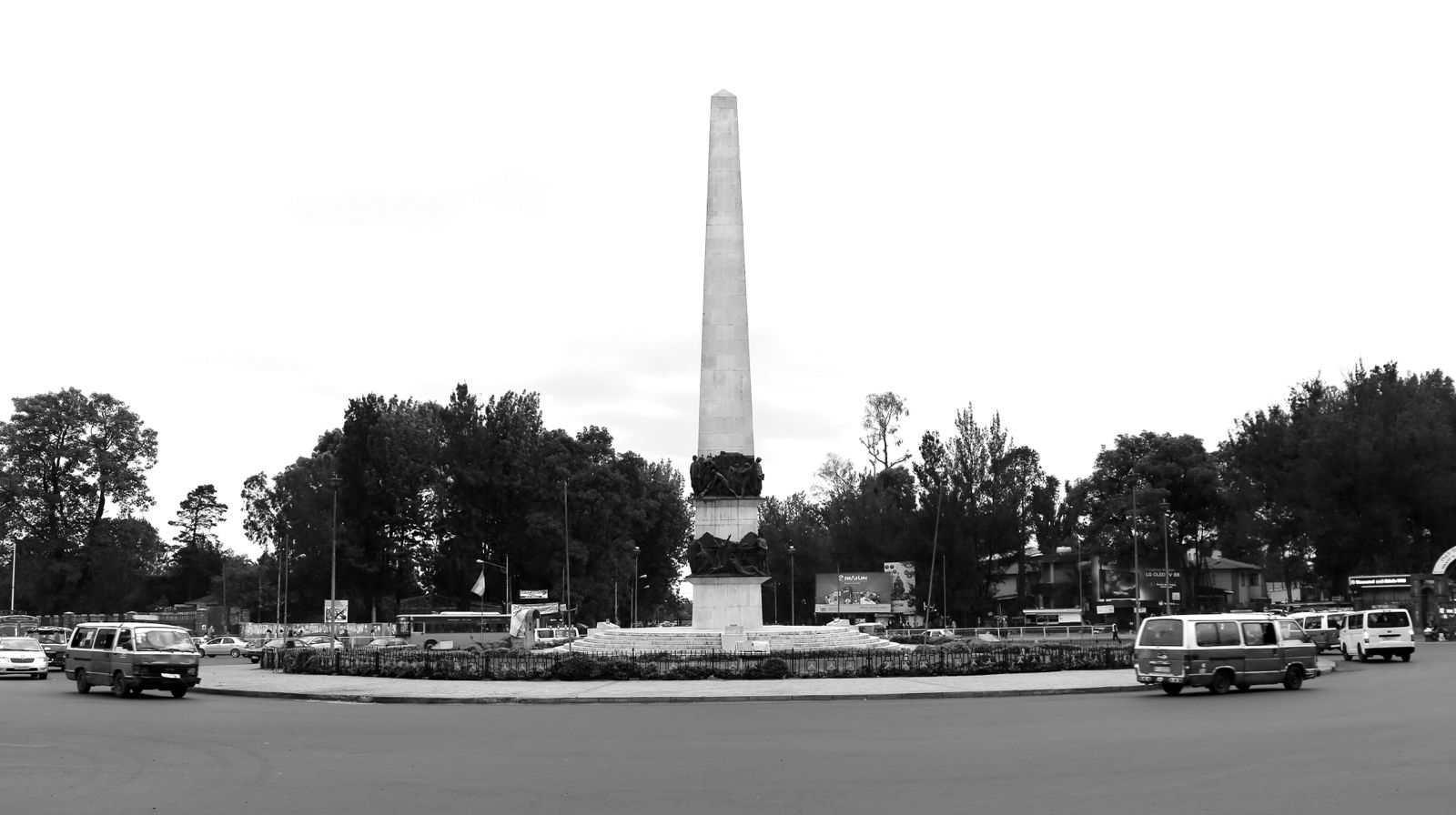
These events are at the core of Ethiopian national memory. The Yekatit 12 monument stands in central Addis Ababa; Martyrs' Day on 19 February is observed with official ceremonies across the country. When Prime Minister Meloni visited Addis Ababa for Italy-Africa summits, she spoke of 'partnership and equal dignity' without reference to the colonial past — a silence parts of the Ethiopian press did not fail to note. Italy has a Mattei Plan for Africa that reproduces the logic of the 2008 Berlusconi-Gaddafi framework: strategic interest without historical reckoning. The continuity is not accidental.
Underlying all this is what Ruth Ben-Ghiat has analysed as the myth of the 'good-natured Italians' — colonisers somehow different from other Europeans, less cruel, more humane. This self-exculpatory narrative served a specific postwar function: it allowed Italy to construct a post-fascist identity without confronting colonial fascism. The cost is the invisibility of the victims, and the impossibility of the honest historical knowledge on which genuine international partnerships must be built.
The Reparations Question: Haiti and the Architecture of Obligation
The Haiti case illustrates the concrete stakes of the resolution's normative trajectory with particular clarity. In 1825, besieged by French warships, the republic born of the slave revolution was forced to pay 150 million gold francs as 'compensation' to former plantation owners — indemnifying its former masters for their own loss of property in human beings. The debt was not settled until 1947, through mediation by National City Bank, which had taken control of the Haitian National Bank during the American occupation of 1915–1934. When President Aristide, in 2003, demanded restitution equivalent to 21 billion dollars, France and the United States collaborated in his removal. Today, gangs control much of the capital. The causal relationship between that 'ransom for independence' and the structural collapse of the Haitian state is precisely what the resolution aims to establish as a principle of international law.
The resolution's language — calling on states to 'engage in a process of justice to redress past wrongs' — is deliberately open. It leaves the full spectrum on the table: formal apologies, development funds, restitution of looted cultural property, commercial redistribution mechanisms. That openness is a political choice that maximised the yes vote; it is also a vulnerability, since each party can interpret 'reparations' as it sees fit. Germany's experience with Holocaust reparations — over €80 billion across decades, combined with property restitution programmes and formal state agreements — demonstrates that such processes are politically possible. Their scale reflects a combination of moral pressure, diplomatic leverage, and the internal political costs of continued denial. For Atlantic slavery, no comparable convergence of pressures has yet been assembled.
An Incomplete Memory
The resolution's symbolic power is real, but so are its blind spots. The Arab-Islamic slave trade — active from the 7th to the 19th century across trans-Saharan, Red Sea, and Indian Ocean routes, and estimated by Ralph Austen and Murray Gordon to have involved between ten and eighteen million people — remains politically peripheral to the global reparations debate. Unlike the Atlantic trade, it was primarily oriented toward domestic, military, and administrative integration of enslaved people rather than plantation labour; its political legacy is correspondingly less contested, a silence that is far from innocent.
Equally, as historian John Thornton documented in Africa and Africans in the Making of the Atlantic World (1992), African elites were active participants in the slave trade, not exclusively passive victims. The resolution does not engage with this complexity. Any reparations process that aspires to genuine transformative power must do so — not out of relativism, but because distributing responsibility accurately is the foundation of a credible claim to justice. A process built on selective historical memory risks becoming an instrument of symbolic politics, satisfying in the short term and corrosive of legitimacy in the long.
None of this diminishes the resolution's significance. Twelve to thirteen million Africans were deported to the Americas in a system that structured the accumulation of capital underlying Western modernity — as David Eltis and Paul Lovejoy have documented with precision in the Slave Voyages Database. The power structures inherited from that system continue to operate: in the income gap between global North and South, in the distribution of natural resources, in migration flows, and in the relative weight of African economies within international institutions whose rules were written by others.
What Comes Next
The vote of 25 March 2026 will not be the last chapter in this process. The resolution opens the door to requests for advisory opinions from the International Court of Justice — opinions that, while non-binding, carry doctrinal weight and accumulate into precedent. It is precisely this incremental trajectory that explains the European abstentions: not opposition to the historical facts, but anxiety about what the next step might require.
For Europe, and for Italy in particular, the choice is not between remembering and forgetting. It is between two modes of engagement with African partners: one built on ignorance or suppression of colonial history, which reproduces in modernised form the same power asymmetries; and one that treats historical accountability as the precondition for the equal partnerships that European foreign policy claims to pursue. The Mattei Plan, like its predecessors, is premised on the former. Whether Italy will ever find the political will for the latter remains an open question — but the 25 March vote has made that question harder to defer.
Mahama's phrase, offered as the resolution's animating purpose — 'understanding how historical injustices have shaped contemporary inequalities' — is not a demand for guilt across generations. It is a demand for knowledge. The general Assembly's vote is non-binding. Symbols, however, matter. Especially when they name what has gone unnamed for too long.