
Why does a wartime state under existential military pressure keep producing this particular kind of crisis? Cycles of scandal, informal concentration of power, public mobilisation, and reshuffle recur without any of them resolving into either consolidated reform or outright state capture.
On 12 July, President Volodymyr Zelensky announced the fourth major overhaul of his wartime government, proposing the removal of Prime Minister Yuliia Svyrydenko less than a year into her term. Defence Minister Mykhailo Fedorov appeared set to lose his portfolio too, after a reported conflict with Commander-in-Chief Oleksandr Syrskyi that had "proved impossible to resolve". Zelensky framed the move as a strategic recalibration. Ukrainska Pravda's own sourcing inside the President's Office tells a more prosaic story: a cabinet built around former chief of staff Andriy Yermak, dissolved partly out of the president's fatigue with a model of government he had relied on since 2022, and partly because Yermak's fall has left an inner circle of "decentralised centres of influence" competing for the space he once occupied alone.
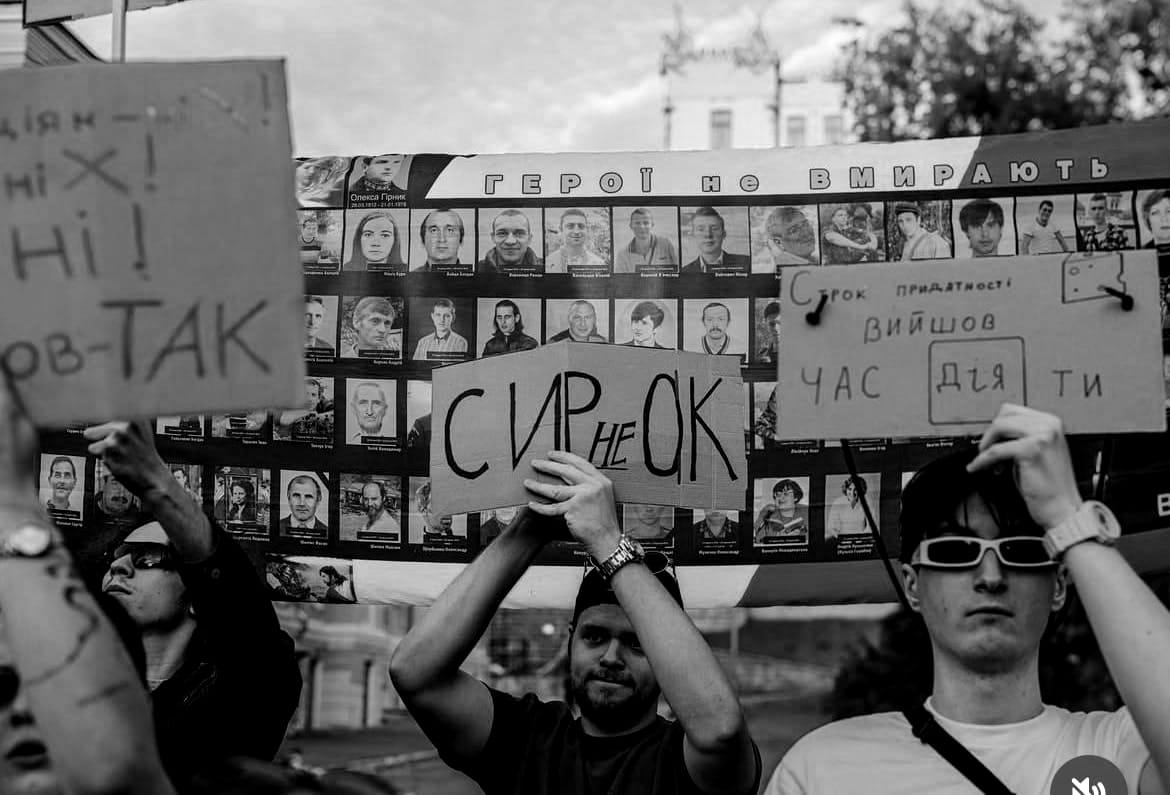
On 15 July, Fedorov's dismissal was confirmed, triggering consequences far larger than the reshuffle itself. What followed was, by several accounts, the largest sustained public mobilisation Ukraine has seen since the full-scale invasion began: thousands filled Kyiv's Ivan Franko Square and squares in at least a dozen other cities for six consecutive evenings of protest, 16 through 21 July, chanting first for Fedorov's reinstatement and, as the crowds grew, for Syrskyi's dismissal too. On 21 July, Zelensky dismissed Syrskyi as commander-in-chief and appointed Joint Forces Commander Mykhailo Drapatyi in his place, a figure protesters had chanted for by name. Fedorov was not reinstated: offered other senior roles, he turned them all down, and organisers resumed the protests on 24 July as an open-ended campaign focused solely on his return, still unresolved at the time of writing.
The real question isn't who replaces whom in Kyiv. It's what the recurrence tells us, and what a mobilisation that has moved from an anti-corruption bureau to the country's top general reveals about where authority in Ukraine's wartime state actually sits. Answering that empirically, rather than impressionistically, is what our RE-ENGAGE research team has spent the past year doing, drawing on a face-to-face survey of 572 respondents conducted in Kyiv between September and early November 2025, and on elite interviews conducted through April 2026 with officials from NABU, the EU Anti-Corruption Initiative (EUACI), the EU Delegation, and the Mykolaiv municipality (see the note on methodology below). Our report, Resilience and Wartime Transformation, offers a framework for reading this crisis that goes beyond factional infighting within the presidential circle.
A Hybrid Regime, Not a Transition
Ukraine's political system has, since independence, developed as a hybrid regime in the sense used in the comparative literature: not a democracy in transition, but a durable arrangement in which pluralist procedures and informal, patronage-based practices coexist and periodically recalibrate against one another. We describe this coexistence through two metaphors: the "theatre state," the layer of government that performs legality, accountability, and reform, and the "shadow state" operating beneath it, where the real distribution of resources, appointments, and loyalty is negotiated.
The numbers are stark. Trust in the national government stands at 30.6 percent in our survey, in national politicians at 19.6 percent, and in bureaucrats at just 10.4 percent. The presidency scores higher, at 50.2 percent, which we read as a personalised evaluation of Zelensky as a wartime figure rather than confidence in the office. Set against this, trust in the Armed Forces reaches 90.4 percent, which we read not as restored vertical legitimacy but as symbolic investment in the institution most directly identified with national survival, while trust in relatives and kin stands at 88.6 percent, among the highest horizontal-trust figures recorded anywhere in the six-country RE-ENGAGE comparative survey spanning Albania, Bosnia and Herzegovina, Georgia, Moldova, Serbia and Ukraine.
A precision is needed here. High interpersonal trust in relatives and kin is not, by itself, a mobilisation technology or an organisational capacity. What connects that orientation to Ukraine's demonstrated ability to fill a square within hours is a distinct fact, documented in our interviews and the secondary literature we draw on: a dense, pre-existing infrastructure of civic association, volunteer networks, veterans' organisations, student unions, and NGOs built up since the 2013–14 Euromaidan and expanded during the 2022 mobilisation, through which that trust finds an organisational channel. It is this infrastructure, layered on top of a default orientation toward informal cooperation, that converts trust into mobilisation capacity, not the trust score alone.
Together, these are what explain Ukraine's wartime resilience: the capacity to keep fighting, keep the civilian economy running, and correct its own political leadership rests on horizontal trust and the infrastructure that channels it, far more than on vertical trust in the state that governs it.
Recurring Crises, Single Pattern
We watched this mechanism operate repeatedly over the course of our project. In July 2025, the Verkhovna Rada passed a law subordinating NABU and SAPO to the Prosecutor General; within days, tens of thousands filled the streets of Kyiv in what became known as the Cardboard Revolution, and the law was reversed within nine days. In November 2025, disclosure of the Energoatom bribery scheme, Operation Midas, implicated senior officials in a kickback system tied to wartime energy contracts. Andriy Yermak, then head of the Office of the President, resigned hours after NABU searched his residence and was later charged with money laundering.
Both episodes make the same duality visible. Yermak has been described as having built, without any electoral mandate, an informal power vertical spanning the presidency, the judiciary, and law enforcement, the shadow state exercising discretion the theatre state's formal offices never show. What followed his resignation was not the dismantling of that vertical but its characteristic response: the reshuffle that followed restaged the appearance of accountability while leaving intact the power architecture that is the structural root of the crisis and that the Global Initiative Against Transnational Organized Crime later found "much of the system remains intact and functional". In both episodes, personnel moved while the credibility of the institutions under attack largely didn't: SAPO's own trust score in our survey, recorded before either crisis had run its course, is an unremarkable 34.3 percent. The correction came from the horizontal, associational infrastructure described above, not from any gain in institutional standing. Our report describes the result as "asymmetric credibility": targeted reforms generate pockets of legitimacy that survive repeated political attack, as NABU and SAPO weathered comparable crises in 2017, 2019, and July 2025, without that legitimacy ever accumulating into trust in the state as a whole. The July reshuffle, described at the outset, fits this same pattern: shadow-state overreach, met by horizontal correction, while vertical trust never moves.
The sack of Fedorov or Asymmetric Credibility's Limit Case
July's reshuffle followed the theatre state's most familiar script: the personnel changed, the structure didn't. Svyrydenko's removal owes less to policy failure than to the redistribution of influence among Yermak's former allies and Zelensky's declining patience with a management style his team had relied on for three years, the same informal, discretionary logic that survived Yermak's own departure now reallocating a different office. Her still-unresolved next posting, after she reportedly declined the Washington ambassadorship offered to her, points less to strategy than to a presidential court managing personal rivalries under exactly the conditions our survey describes: low vertical trust, high informal discretion.
What sharpens the case considerably is Fedorov's own record. In six months in office he had, by his own detailed tally and independent Kyiv Independent reporting, restricted Russian forces' battlefield access to Starlink, launched the Logistics Lockdown campaign that helped tighten the drone siege of Crimea, overseen improved drone and cruise-missile interception rates, and introduced fixed-term military contracts that lifted infantry and assault combat pay toward $7,000 a month, among the highest rates in any army. One active-duty serviceman told Kyiv Independent he had "accomplished more in six months than others did in three years", yet none of it protected him: his removal was not adjudicated against these results but followed an unresolved personal standoff with Syrskyi that Zelensky himself reduced to a binary: unity had not been achieved, and "the way out is either one side or the other." It reflects the shadow state's logic: performance was never the criterion governing the decision at all. A minister whose reforms were, on the available evidence, working was removed through the same informal, relationship-based mechanism that reshuffled Svyrydenko's cabinet and, a year earlier, absorbed Yermak's fall: conflict avoidance standing in for the accountability a theatre state is supposed to perform.
The dispute with Syrskyi was framed publicly as doctrine: in a 16 July briefing, Fedorov accused the General Staff of sabotaging his contract reform, and said that rather than working out how to defeat Russia asymmetrically, Syrskyi had "figured out how to split the country". But the substantive charge beneath the doctrinal one was structural: commanders in mechanised brigades holding the front have told the Kyiv Independent that supplies and priority went disproportionately to assault units within Syrskyi's own command culture, while units judged on results elsewhere in the chain went under-supplied. If accurate, it's the shadow state's characteristic mechanism, informal, loyalty-based allocation beneath a formally unified command, showing up for the first time inside the Armed Forces rather than the civilian bureaucracy where our fieldwork had previously found it.
That location inverts the pattern the two earlier crises established, turning this into a limit case for asymmetric credibility. In July 2025 and November 2025, mobilisation confronted institutions that were not, on their own, especially trusted, SAPO scores 34.3 percent. Here, the institution facing pressure was the one our respondents trust more than any other, the Armed Forces, at 90.4 percent, symbolic investment, in our reading, rather than restored vertical legitimacy. Asymmetric credibility describes legitimacy that stays local and never hardens into blanket immunity; by the second consecutive day of demonstrations, chants had shifted to include Syrskyi's removal, and on 19 July naval and airborne commanders answered with the opposite claim (defending Syrskyi and warning against attempts to "divide society") that the institution's symbolic standing should convert into the blanket immunity asymmetric credibility elsewhere denies.
That inversion did not hold, at least not entirely. On 21 July, Zelensky dismissed Syrskyi and appointed Drapatyi, a commander protesters had chanted for by name. A Rating Group poll conducted that same weekend found 55 percent of Ukrainians supported Syrskyi's removal against 15 percent opposed, confirming that the commanders' claim to immunity had not, in the end, converted the Armed Forces' trust score into protection for its leadership. But the mobilisation's reach stopped there. The same poll found 72 percent opposed Fedorov's own dismissal, against 5 percent in favour, and Zelensky has still not reinstated him: offered other senior positions, Fedorov turned them down because, according to a Defence Ministry source, "he doesn't need a token position", and organisers resumed daily protests on 24 July demanding his return specifically. This episode marks the boundary of asymmetric credibility: horizontal mobilisation proved able to remove a commander once his conduct became the object of public contestation, but not to compel the president to hand a specific ally a specific office, still less to overturn a personnel decision the president had made for reasons unrelated to that ally's measurable performance. Here, mobilisation delivered accountability but not reinstatement.
What This Means for the EU
This framework sharpens what is at stake for the EU, whose democracy promotion strategy in Ukraine our report examines directly. The EU enjoys a level of legitimacy in Ukrainian public opinion that is, by any comparative standard, very high: 63.8 percent overall trust, and 65.1 percent of respondents would select the EU as their preferred mediator in a hypothetical peace negotiation. Yet awareness of the EU's own governance programmes remains strikingly low: only 28.1 percent had heard of EUACI, and just 9.9 percent of Pravo-Justice. We describe this as the gap between the EU functioning as a "political horizon," an aspirational symbol of post-war stability, and the EU functioning as an effective, concretely experienced governance actor. Reshuffles of the kind Ukraine has now seen four times since the invasion do nothing to close that gap; they risk widening it, by renewing formal reform commitments at the level of personnel while leaving the shadow-state incentives that produced Midas untouched, precisely the risk the literature on EU conditionality identifies under the label of "stabilitocracy."
The EU's own engagement with the reshuffle illustrated the same gap in miniature. European Commission President Ursula von der Leyen held her first call with incoming Prime Minister Koretskyi within days of his nomination, pledging continued support for energy-sector governance reform. That channel functioned smoothly through the reshuffle and the protests that followed, a reminder that the EU's relationship with Ukraine still runs, by default, through the formal governance actor our respondents know least well, rather than through the horizontal civic networks now doing the more visible work of holding power to account.
A separate policy brief synthesising RE-ENGAGE's Ukraine, Georgia and Moldova findings sets out the priorities that follow from this gap: open EU civil-society funding to smaller, less formal networks rather than concentrating it among large capital-city organisations; anchor reform at municipal level, following the Integrity Cities model EUACI runs with Mykolaiv, while reserving national conditionality for accession screening; and close the visibility gap directly, since 57.6 percent of respondents report no awareness of local civil-society trust-building work at all.
Conclusion
Our fieldwork points to where the correction has actually come from, and it is not from conditionality. Three times now, a leadership otherwise disinclined to supply accountability has been forced into a response, not by the trust score itself but by what that score indexes: dense networks of students, veterans, NGO activists, and volunteers whose capacity for rapid, self-organised mobilisation we trace, following Channell-Justice's account of Euromaidan, back to 2013–14 and beyond. What was different the third time was the target, and the outcome was correspondingly split. The first two episodes tested whether this civic infrastructure could discipline a distrusted political and administrative elite; the third tested whether it could also discipline the one institution the same citizens trust more than any other, and it did: Syrskyi's dismissal is, by this evidence, the first time this mechanism has reached a sitting wartime commander-in-chief. But mobilisation proved able to remove a contested figure without being able to compel his replacement with a specific preferred ally. Fedorov remains outside government despite a record of results nobody has seriously disputed on the merits.
Ukraine's wartime state has not yet had to choose between its theatre and its shadow, because horizontal trust has repeatedly done the work vertical accountability has not, including now against the country's own commander-in-chief. That is a genuine achievement of Ukrainian civil society. It isn't, on its own, a substitute for institutional reform. A state Ukrainians do not yet trust is still being defended by a society that trusts itself, a society that can remove its most trusted institution's leadership once that leadership's conduct becomes contested, but cannot yet compel the positive choice its still-unresolved campaign for Fedorov continues to test.
Note on Methodology
The data cited here were collected by the RE-ENGAGE research team: a face-to-face survey of 572 respondents in Kyiv conducted between September and early November 2025, triangulated against elite interviews with NABU, EUACI, Pravo-Justice, the EU Delegation, and the Mykolaiv municipality conducted through April 2026. Security conditions made nationwide sampling impossible; the survey is representative of Kyiv, not of Ukraine as a whole. Ukraine is one of six cases in the RE-ENGAGE comparative survey, alongside Albania, Bosnia and Herzegovina, Georgia, Moldova and Serbia.
Protesters in Kyiv holding a banner with the portraits of the Heavenly Hundred – the protesters killed during the Revolution of Dignity. Credit photo: Julia Kochetova (https://www.instagram.com/p/DbDDm1ql-W2/?img_index=4)